Filipino (Tagalog), the national language of the Philippines, has approximately 75 to over 90 million speakers worldwide. There are 28–33 million native speakers and over 50 million second-language speakers in the Philippines, the home country. The language has a significant international presence due to the diaspora, with large populations in the US, Saudi Arabia, Canada, and the UAE. In the US, there are 1.3-1.7 million speakers of Filipino /Tagalog. Filipino. It is the 3rd or 4th most widely spoken language in the US.
Filipino is the national language of the Philippines where more than 120 native languages are spoken. It is also the term used for the citizens of the country where the language originated. In the US, the most popular Philippine language is Tagálog which was declared the basis of the national language in 1937 when the Philippines was a Commonwealth under the United States. In 1946, after WW II, the Philippines became independent from the colonial rule of the U.S. Tagalog was renamed Pilipino in 1959 and in 1987, it was renamed Filipino with borrowings from other Philippine and international languages, mainly from Spanish and English, owing to more than 350 years of Spanish imposition and 48 years of American colonization from 1898 to 1946; however, American rule was interrupted by the Japanese occupation from 1941 to 1945.
Filipino Language at UCLA
In the ’60s, communities of color and other marginalized groups fought for civil rights and were involved in national and international movements for liberation. There were significant historical events that paved the way for the establishment of Ethnic Studies and the teaching of languages other than English: the Civil Rights Act of 1964, Voting Rights Act of 1965, and Immigration Act of 1965; Watts Riot in 1965; the 1965 Grape Strike started by Filipinos which lasted for five (5) years; and the San Francisco State College Third World Liberation Front strike from Nov. 6, 1968-April 1969- the longest student strike in US history.
In 1960, Tagalog was the first Southeast Asian Language to be offered among the five South and Southeast Asian Languages now being taught under the program, i.e., Hindi/Urdu, Indonesian, Tagalog/Filipino, Thai, and Vietnamese. In Winter 1993, Tagalog was offered by the Linguistics Department. It was moved to the Applied Linguistics Department in the Fall of 1995 where it became part of the South and Southeast Asian Languages Program along with Hindi, Thai, and Vietnamese. In the fall of 1999, Tagalog was taught as part of the South and Southeast Asian Languages and Cultures (SSEALC) Program housed in the Department of East Asian Languages and Cultures (EALC), later renamed Asian Languages and Cultures (ALC). In Fall 2001, the course name was changed from Tagalog to Filipino, the national language of the Philippines, as mandated by the 1987 Philippine Constitution.
Program Objectives
The Filipino Language Program helps you communicate confidently in Filipino — in everyday life, academic settings, and professional environments. You will explore Philippine history, values, and culture while building critical thinking and bilingual skills. Whether you are majoring, minoring, or simply expanding your horizons, this program prepares you for a globally connected world.
- Develop the student’s ability to communicate and interact effectively and appropriately in various situations by teaching the grammar and Filipino culture fostering cultural awareness, understanding, and critical thinking.
- Communicative competence in common everyday situations, academic, professional, and cross-cultural situations
- Comprehension of Philippine history and appreciation of Filipino culture and values.
- Achieve academic or professional fluency in the language and culture among students who would major or minor in Filipino language.
The program aims to build global communication skills valued by employers, enhance the learner’s skills set with bilingual competency. Aside from linguistic and sociolinguistic skills, the course aims to inculcate discipline, honesty, consistency, and academic rigor which would serve them well in their future undertaking.
Filipino Language Instructional Faculty
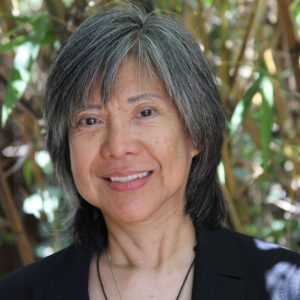
Nenita P. Domingo
Senior Lecturer
domingo@humnet.ucla.edu
Curricular Roadmap
All Filipino courses are content-based and are designed to improve the communicative competence of the learner by teaching the culture and social rules, along with the linguistic concepts (grammar rules) following the U.S. National Standards for Foreign Language Learning. The classes use the functional-situational, content-based, translation, and grammar approaches in teaching the language.
For heritage learners, the courses celebrate and build on what you already know. For new language learners, Filipino 1 Introductory Filipino starts from the very beginning. In these mixed classes, we build a collaborative community of learners where students with exposure to the language and culture provide cultural context, vocabulary and native-like fluency while the second-language learners provide knowledge about the grammar and formal speaking and writing skills.
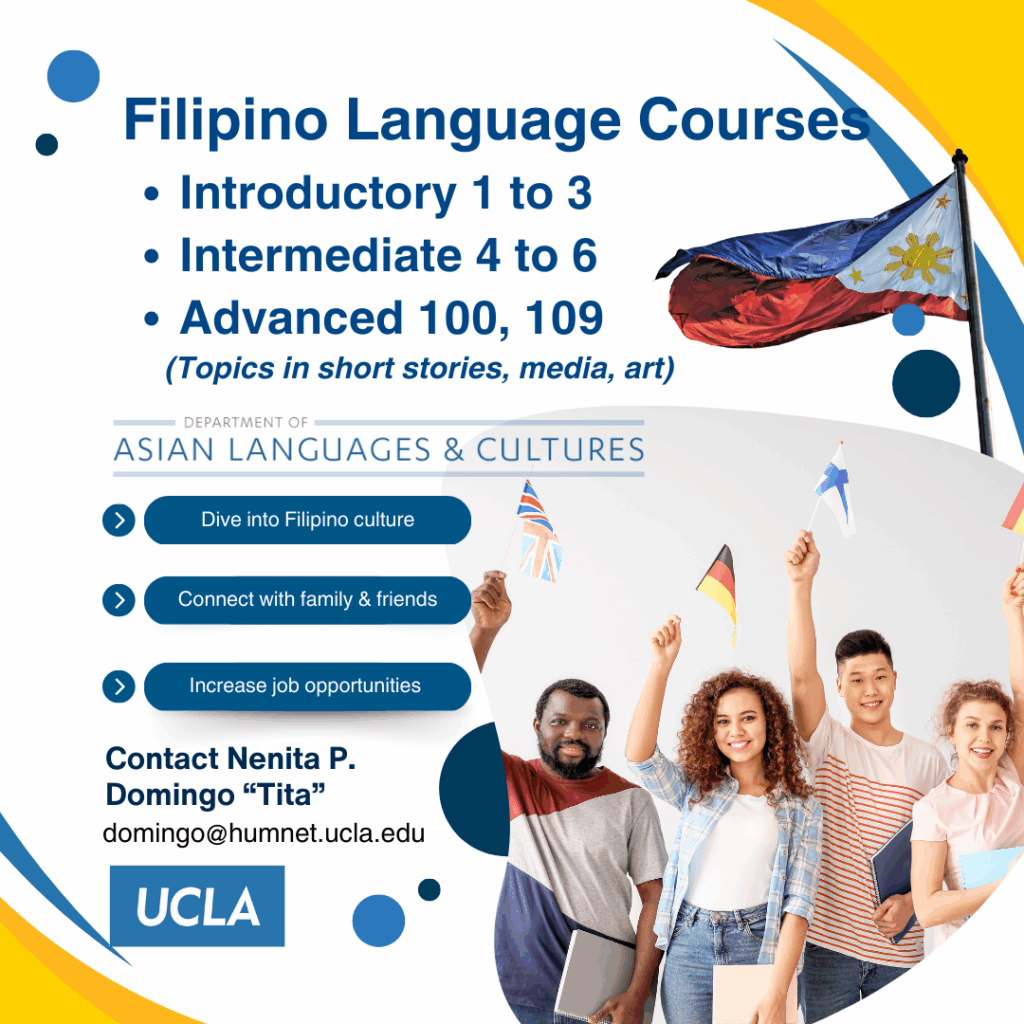
Filipino 1-2-3 Introductory Filipino
This is a three-quarter sequence course designed for the beginning student with little or no knowledge of Filipino. The Fall quarter focuses on the sounds and rhythm of the language, vocabulary building, and basic sentence patterns. The Winter quarter places a stronger emphasis on vocabulary building, mastery of Filipino sentence patterns, and development of the student’s reading skills. Spring introduces more grammatical structures as well as integrates the material covered in Fall and Winter. Each quarter is a 5-unit course.
For the introductory courses, you will:
- Speak Filipino with correct pronunciation and natural intonation
- Listen and understand everyday Filipino conversations
- Write simple sentences and short compositions
- Read basic Filipino texts with confidence
- Explore Filipino culture, values, and traditions
Language Skills You’ll Build
- Basic vocabulary for everyday situations
- Essential grammar explained simply and clearly
- Pronunciation skills through guided practice
- Cultural competency through authentic Filipino media and experiences
Filipino 4-5-6 Intermediate Filipino
This is a three-quarter sequence course in second year Filipino. It is intended to improve the communicative competence of the student by teaching the social rules along with the linguistic rules of Filipino.
Throughout the year, students are introduced to more advanced vocabulary and grammatical structures which they learn to use in expanded conversations. Integration and reinforcement of material from first and second year Filipino courses are made through various class activities. Each quarter is a 5-unit course.
Advanced Filipino Courses
Advanced Filipino courses prepare a student to delve deeper into critical and analytic study of his / her personal academic field to achieve high level proficiency in reading, writing, speaking, and listening comprehension through sophisticated academic, literary, and cultural studies readings, and authentic media.
Filipino 100 A Reading and Writing in Filipino (2024) (Formerly numbered SEASIAN 172A Advanced Filipino Reading & Writing 2005, Fall 2007)
Filipino 109 Advanced Tutorial (2025)
External Resources
Tara, Mag-Tagalog Tayo! Workbook